


AI is now part of everyday marketing. It helps teams draft content, analyze search behavior, build customer segments, and respond faster. But speed is not the same thing as trust. As more customers see generic AI-written posts, automated replies, and polished-but-empty brand messages, the brands that feel human will become easier to believe.
That is where anti-AI marketing comes in. It is not a rejection of AI. It is a human-first approach to using AI responsibly while making your brand more transparent, useful, and recognizable. For small businesses, this matters because trust is often the real advantage. You may not outspend a larger competitor, but you can sound clearer, act more honestly, and show the real people behind the work.
Debranding is one of the practical ways to do that. It strips away excess polish, vague messaging, and overdesigned brand noise so customers can see what your business actually stands for. In 2026, when AI-generated marketing is easier to produce than ever, that clarity can help protect customer trust.
Why AI Trust Is Becoming a Marketing Issue
AI adoption keeps accelerating. The AI Index notes rapid growth in generative AI use across organizations and industries. That growth creates real opportunity, but it also raises a simple customer question: “Was this made for me, or was it generated at scale?”
Many people are willing to use AI, but that does not mean they fully trust every AI-driven interaction. Klaviyo research found that only a small share of consumers completely trust AI, while many are neutral, uncertain, or cautious. That is important for marketers because trust is not built by automation alone. It is built by relevance, honesty, consistency, and proof.
There is also a compliance side. The FTC action. In plain terms, brands should avoid exaggerating what AI can do, hiding important limitations, or using AI in ways that mislead customers. Ethical AI use is not just a brand preference; it is part of responsible marketing.
So the issue is not whether businesses should use AI. Most will. The issue is whether AI makes the customer experience more useful and honest, or whether it makes the brand feel less personal and less trustworthy.
What Anti-AI Marketing Actually Means
Anti-AI marketing does not mean “never use AI.” It means your brand does not let AI become the voice, judgment, or personality of the business. AI can support research, outlining, reporting, search analysis, and operational workflows. The final message, customer promise, creative direction, and relationship-building still need a human point of view.
A good anti-AI marketing strategy usually includes four principles:
- Human review: AI-assisted content should be checked by someone who understands the customer, the offer, and the brand’s standards.
- Clear value: Every page, post, email, or ad should answer a real customer question instead of simply filling a content calendar.
- Transparent communication: Avoid fake expertise, fake urgency, fake testimonials, and exaggerated AI claims.
- Visible people: Show the founders, team members, process, customer stories, and decisions behind the business.
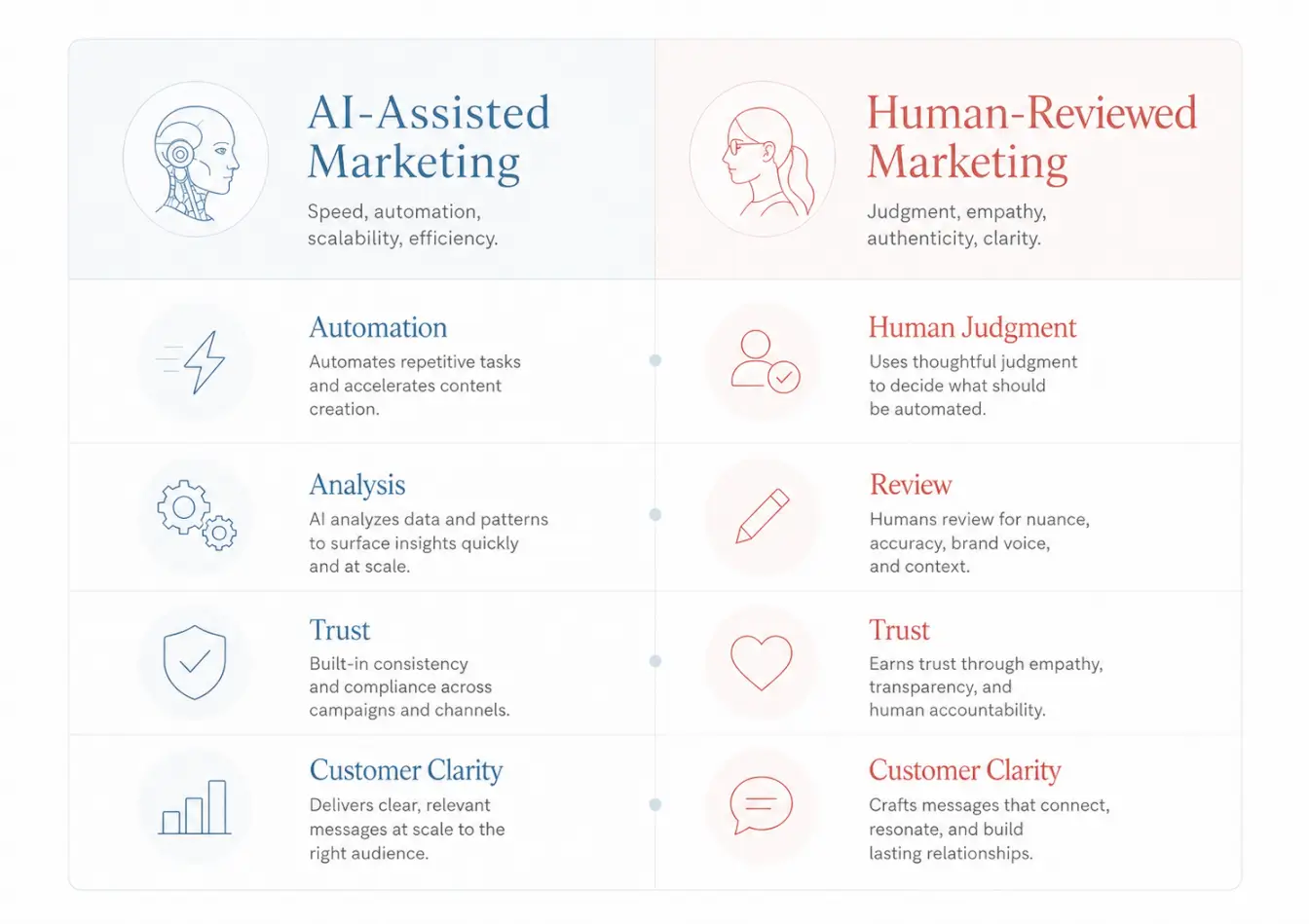
This is especially important for service businesses. Customers are not only buying a deliverable. They are choosing who to trust with their website development, marketing budget, brand, or business growth. A human-first message can reduce doubt before the first consultation ever happens.
Debranding: The Practical Side of Anti-AI Marketing
Debranding is the process of removing unnecessary brand clutter so the core of the business becomes easier to understand. It does not mean deleting your logo, abandoning design, or making your company look plain. It means simplifying anything that gets between the customer and the truth of your offer.
In an AI-heavy marketing environment, many brands start to sound the same. They use the same motivational language, the same abstract promises, and the same overpolished visuals. Debranding helps you move in the opposite direction. It makes your brand more specific, direct, and grounded.
For a small business website, debranding can include:
- Replacing vague hero copy with a clear statement of who you help and what outcome you create.
- Cutting generic AI-written blog posts that do not show original experience.
- Using real project examples, process notes, screenshots, or case studies instead of broad claims.
- Making service pages easier to scan and less dependent on buzzwords.
- Showing authentic team photos, founder notes, or client context where appropriate.
This also supports SEO and AI search visibility. Search engines and AI answer systems increasingly reward content that is clear, useful, and grounded in real expertise. Digital Style Designs already works in this direction through AI SEO and answer-engine optimization, where structured, credible content helps a business become easier to understand by both people and AI systems.
Where Brands Usually Start Sounding Too AI-Generated
You do not need to reject AI to notice when your brand starts feeling automated. The warning signs are usually easy to spot:
- Your website uses polished phrases that could describe almost any competitor.
- Your blog answers broad questions but does not include your own examples, opinions, or experience.
- Your social posts sound motivational but do not say anything specific.
- Your emails feel personalized in name only.
- Your customer support replies are fast, but they do not answer the real concern.
These issues are common because AI is good at producing smooth language. But smooth language is not always memorable. Customers remember useful details, honest explanations, and moments that feel like a real person paid attention.
A Debranding Framework for Small Businesses
The goal is not to make the brand smaller. The goal is to make it clearer. Use this framework to review your website, content, and customer touchpoints.
| Debranding Area | What to Improve | Why It Builds Trust |
|---|---|---|
| Core message | Replace vague claims with a clear audience, service, and outcome. | Customers understand faster whether your business is relevant to them. |
| Website content | Remove generic filler and add examples, process details, and proof. | Specificity signals real experience and reduces skepticism. |
| AI use | Use AI for support tasks, but keep human review in strategy and publishing. | The brand benefits from efficiency without losing judgment or voice. |
| Visual identity | Simplify layouts, reduce unnecessary decoration, and make information easy to scan. | Clear design makes the business feel more confident and less performative. |
| Customer experience | Add human fallback options, better support context, and honest expectations. | People trust brands that make it easy to get a real answer when it matters. |
How to Use AI Without Losing Your Human Voice
The strongest brands in 2026 will not be the ones that avoid AI completely. They will be the ones that use it with taste, restraint, and accountability.
AI can help you identify content gaps, organize keyword research, summarize customer questions, and draft first-pass ideas. It can also support AI agent workflows that save time across operations. But AI should not be the final authority on what your business says or promises.
A practical rule: use AI to speed up the work behind the message, then use human judgment to make the message worth trusting.
For example, AI can help draft a service page outline. A human should add the real customer objections, the actual process, the proof points, the pricing context, and the decision-making details. AI can summarize reviews. A human should decide which insights are meaningful and how to respond to them. AI can suggest blog topics. A human should choose the ones that reflect real expertise and business priorities.
What This Means for SEO and AI Search
Anti-AI marketing and debranding are not only brand strategies. They also support discoverability. Search engines and AI answer platforms need clear, structured, credible information to understand what a business does. Customers need the same thing.
That is why generic AI content is risky. It may add pages to a website, but it often fails to add authority. Strong SEO content should include original insight, useful structure, internal links, external support where appropriate, and a clear connection to the services the business actually provides.
This is also where answer engine optimization becomes relevant. If AI answer systems are summarizing businesses for users, your website needs to state your expertise plainly. A debranded website with clear service pages, helpful FAQs, schema markup, and human-reviewed content is easier for both customers and AI systems to interpret.
The Future Is Not Anti-Technology. It Is Pro-Trust.
Anti-AI marketing is best understood as a trust strategy. It reminds brands that automation should support the customer relationship, not replace it. Debranding turns that idea into action by removing the vague, overproduced, and generic parts of a brand experience.
For small businesses, this can become a real advantage. You do not need the biggest content machine. You need a brand that feels specific, honest, and useful. You need a website that explains your value clearly. You need content that sounds like it came from people who actually do the work.
In 2026, the brands that keep customers will not simply be the ones using AI the most. They will be the ones using AI responsibly while making their human value impossible to miss.
FAQ: Anti-AI Marketing and Debranding
What is anti-AI marketing?
Anti-AI marketing is a human-first way to use technology. It does not mean avoiding AI completely. It means AI can help with research, planning, or first drafts, but the final message still needs human judgment, real experience, and a clear point of view.
What does debranding mean?
Debranding means simplifying the parts of a brand that create noise. That might include a cleaner logo, plainer language, fewer generic claims, or a website that explains the offer more directly. The point is not to erase the brand. The point is to make it easier to trust.
Why are companies debranding?
Companies debrand when their marketing starts to feel too polished, too busy, or too similar to everyone else. A simpler brand can feel more direct and more honest, especially now that customers see so much AI-generated content. For small businesses, that clarity can be a real advantage.
What is the difference between rebranding and debranding?
Rebranding usually changes how a company presents itself: the name, visuals, positioning, audience, or offer. Debranding is narrower. It removes extra layers so the brand feels clearer and less manufactured. A business can debrand without doing a full rebrand.
Can small businesses use AI and still sound authentic?
Yes. Small businesses can use AI for research, outlines, reporting, and first drafts. The important part is what happens next. Add real examples, edit the claims, check the tone, and make sure the final version sounds like the people who actually run the business.
Should brands disclose when they use AI?
It depends on the situation, but brands should never make AI use misleading. If AI affects a customer’s decision, a recommendation, a testimonial, or a service outcome, transparency is usually the safer choice. It also feels better to customers than pretending everything was fully human-made.
How does anti-AI marketing connect to SEO?
It connects through trust and clarity. Search engines and AI answer systems need content they can understand. Customers need the same thing. Human-reviewed pages with clear answers, useful examples, accurate claims, and clean structure are stronger than generic AI pages written just to fill space.
The Bottom Line
AI can make marketing faster, but it cannot replace trust. If your website, content, or customer experience is starting to sound generic, it may be time to simplify the message and bring the human side of your brand forward. Want to make your content clearer for both customers and AI search systems? Start with a focused AI SEO strategy or contact DSD for a practical website and content review.