

SEO Maintenance vs One-Time SEO Audit: Which One Actually Improves Rankings?
If you are currently debating between investing in ongoing SEO maintenance vs one-time SEO audit services, you are asking the exact right question. Many business owners assume that paying an agency to look at their website once will somehow magically increase their traffic.
Unfortunately, the internet does not work like that anymore.
Google updates its core ranking algorithm thousands of times every single year. A strategy that works in January might be completely obsolete by July. Let’s break down the exact difference between an audit and ongoing maintenance, and figure out which one actually drives revenue for your business.
What is the difference between SEO maintenance vs one-time SEO audit?
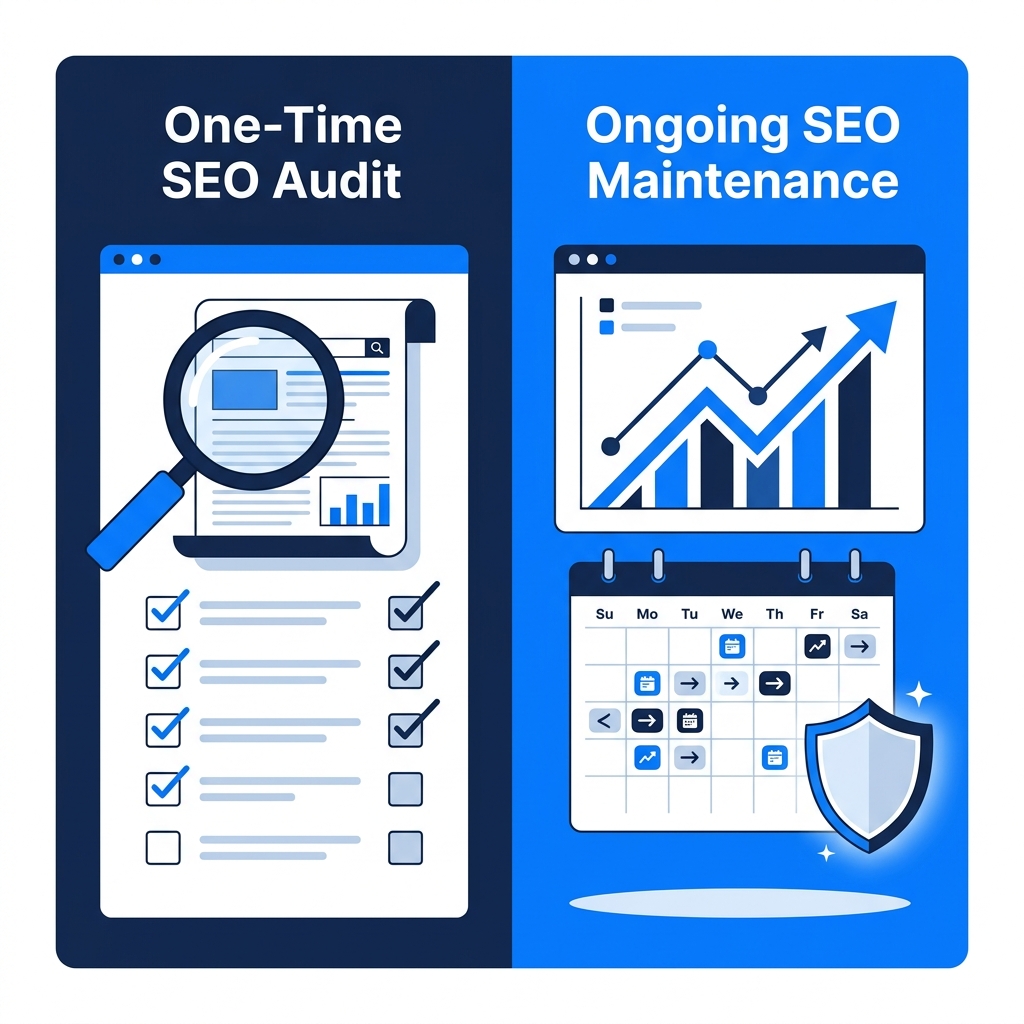
An SEO audit is a diagnostic report that identifies technical errors, broken links, and missing keywords on your website at a single, specific moment in time. SEO maintenance is the continuous monthly execution of fixing those errors, building new localized content, and adapting to Google’s ever-changing algorithm updates to actually improve your organic rankings.
Think of an audit like taking your car to the mechanic for a full diagnostic inspection. The mechanic hands you a twenty-page printout listing every single thing wrong with your engine.
An audit tells you what is broken. But the audit does not fix the car. If you take that piece of paper, put it in your glovebox, and drive away, your car is still broken. SEO maintenance is the act of actually hiring the mechanic to fix the engine, rotate the tires, and change the oil every few thousand miles so the car never breaks down in the first place.
The Allure of the One-Time SEO Audit
It is easy to see why small businesses love the idea of a one-time audit. It feels incredibly safe. You pay a flat fee, usually between five hundred and two thousand dollars, and you get a massive, highly detailed PDF report in return.
You feel like you accomplished something. You have a roadmap.
The problem is that most businesses lack the internal technical skills to actually execute the roadmap. When an audit tells a local plumbing company that they need to implement dynamic JSON-LD schema markup and reduce their server response time by 400 milliseconds, the business owner usually freezes. They do not know how to write schema code. They do not know how to optimize a server cluster.
So the expensive audit just sits in a digital folder gathering dust. According to Search Engine Journal, thousands of audits go completely un-implemented every year because clients do not have the technical bandwidth to do the work.
Why a One-Time SEO Audit is Never Enough
Even if you have an internal developer who can fix all the errors listed in the audit, your website is still not safe.
Search Engine Optimization is a highly competitive, living ecosystem. If you fix your website today, it will be perfectly optimized for exactly one day.
Tomorrow, your biggest competitor might publish three new, highly authoritative blog posts. The next day, Google might roll out a massive core algorithm update that completely changes how it views mobile page speed. A week later, a WordPress plugin update might break your site’s header structure.
A one-time audit captures a snapshot of the past. It cannot protect you from the future.
The ROI of Continuous SEO Maintenance
This is why serious businesses invest in continuous monthly maintenance. SEO maintenance is a proactive defense and offense strategy rolled into one.
When you hire an agency on a monthly retainer, they do not just hand you a list of problems. They actively fix the problems in the background while you focus on running your company. Here is what actual SEO maintenance looks like in practice.
1. Active Algorithm Defense
When Google announces a new Helpful Content update, a maintenance team immediately audits your site against the new rules. If the algorithm suddenly prefers highly bursty, conversational text over rigid keyword stuffing, your team goes in and rewrites your core pages before your rankings ever drop.
2. Continuous Content Gap Analysis
Your competitors are constantly trying to steal your keywords. SEO maintenance involves tracking your competitors every single week. If a rival agency starts ranking for “emergency roof repair,” your maintenance team immediately builds a better, deeper, more authoritative page to take that keyword back.
3. Technical Degradation Repair
Websites naturally degrade over time. Links break. Images get corrupted. Database tables get bloated. A dedicated maintenance team runs weekly technical sweeps to fix these invisible errors. They ensure your site remains lightning fast, which is a critical ranking factor according to Google Search Central.
4. Local Authority Building
You cannot build local authority overnight. You cannot just submit your site to a directory once and expect to rank in the Google Map Pack. SEO maintenance involves the slow, steady acquisition of high-quality local citations, localized blog content, and continuous Google Business Profile optimization.
When Should You Actually Buy a One-Time Audit?
Does this mean one-time audits are completely useless? No. There are exactly two scenarios where a one-time audit is the correct choice.
First, if you are planning a massive website migration or redesign. Before you launch a new site, you need an audit to ensure you have mapped all your old URLs properly so you do not lose your existing traffic.
Second, if you have a massive, highly skilled internal marketing team. If you employ full-time copywriters and dedicated web developers, you do not need to outsource the execution. You just need an external expert to provide the strategic roadmap.
For the other 95 percent of small businesses, a one-time audit is usually a waste of money if it is not immediately followed by an execution contract.
How to Transition from Auditing to Maintaining
If you are tired of paying for reports that do not actually increase your phone calls, it is time to shift your budget.
Stop looking for a quick fix. Start interviewing agencies that offer long-term partnerships. Ask them exactly what they will do in month three, month six, and month twelve of your contract. A good agency will have a clear, documented execution pipeline. They should be focused on building your topical authority and fixing your technical debt on a rolling schedule.
The Bottom Line
When you weigh SEO maintenance vs one-time SEO audit investments, the math is simple. An audit provides a temporary map. Maintenance provides the vehicle, the fuel, and the driver to actually get you to your destination. Stop buying lists of problems and start investing in execution. If you are ready to start actively growing your traffic, SEO plans or reach out to our team to schedule a free initial consultation.