

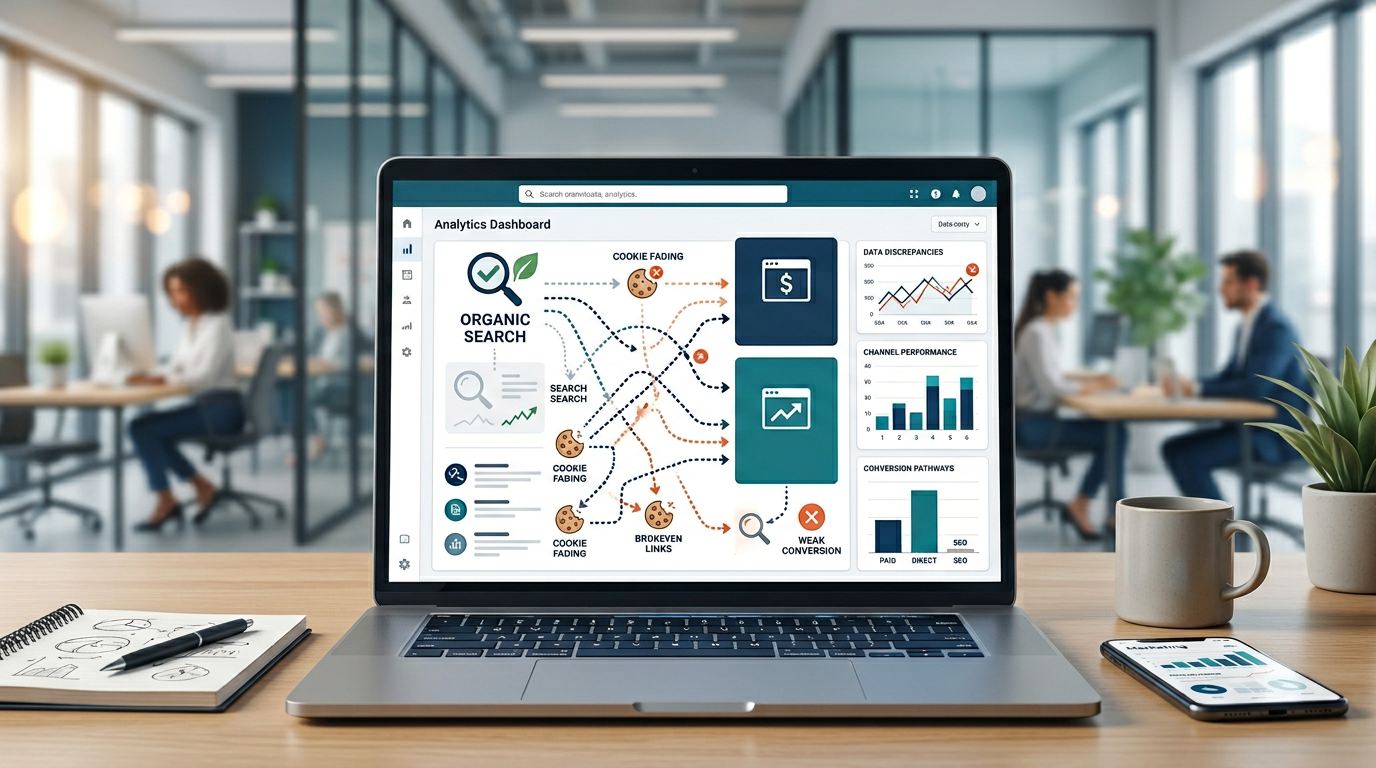
If you stare at GA4’s attribution reports long enough, SEO can look like a weak support act while paid campaigns steal the spotlight. Yet in real life, organic search is often how people first find you, compare you, and come back when they’re finally ready to buy.
The gap between what the reports show and what’s actually happening has only widened with privacy changes, broken cross‑device tracking, and AI‑driven “zero‑click” search experiences that drive awareness without always sending a click.
Quick Refresher: What Attribution Models Try to Do
Attribution models are simply rules for how to assign “credit” for a conversion across all the touchpoints in a customer journey. Common ones you’ll see in GA4 and other tools include:
- Last click: 100% credit to the final touchpoint.
- First click: 100% credit to the first touchpoint.
- Linear: Equal credit to every touchpoint.
- Time‑decay / position‑based: More credit to late or first+last touches.
- Data‑driven (DDA): Machine learning spreads credit across touchpoints based on observed patterns.
On paper, these models help you decide which channels and campaigns “deserve” your budget. In practice, they’re fine for simple paid funnels—but they start breaking down when you apply them directly to SEO.
Table: Where Attribution Models Clash With SEO Reality
| Model type | What it assumes | Why it breaks for SEO |
|---|---|---|
| Last click | Final click did the heavy lifting | Over‑credits branded search/direct, under‑credits discovery content. |
| First click | Discovery is everything | Over‑credits top‑funnel, ignores nurturing and conversion content. |
| Linear | All touchpoints are equal | Treats a blog skim and a high‑intent service page as the same action. |
| Time‑decay | Later touches matter most | Still pushes credit to channels that just “harvest” existing demand. |
| Data‑driven (DDA) | Enough clean data exists to learn the true pattern | Needs high volume; below thresholds it collapses back to last‑click. |
Even multi‑touch and DDA models rely on assumptions that don’t reflect how people really research, bookmark, and return to sites through organic search.
Reason 1: SEO Often Starts Journeys That Convert Somewhere Else
Default models in tools like GA4 and many CRMs were never built with SEO’s “assist” role in mind. A typical pattern:
- User finds a helpful blog via non‑branded organic.
- They leave, think, maybe bookmark you.
- Days later they Google your brand name or click a retargeting ad and convert.
Last‑click and many low‑data DDA setups hand 100% of that win to branded search, direct or paid—even though the only reason that user trusted you enough to convert was the first organic touch.
Reason 2: AI Overviews and Zero‑Click SERPs Hide SEO’s Influence
With AI Overviews, featured snippets and other rich results, more and more searches end without a click. Studies show AI Overviews can cut clicks from result pages by around a third, even as impressions rise and overall lead quality improves.
So your content is still doing work—being quoted in AI answers, shaping opinions, and building brand familiarity—but your analytics see fewer sessions and conversions attached to “Organic Search.” That makes traditional attribution look worse just as search is becoming more generative and assistive.
Reason 3: Cookie Deprecation and Privacy Sandboxes Break Journeys
Attribution has always depended on stitching together touchpoints with cookies and tracking parameters. Third‑party cookie deprecation in browsers like Safari and Firefox, and Google’s evolving Privacy Sandbox, are undermining that foundation.
When cookies expire faster or don’t fire at all, the path from “found you via SEO” to “came back via another channel and converted” fractures. Models then over‑assign conversions to “Direct” or whichever last channel still shows up correctly, while SEO’s role quietly disappears from the report.
Reason 4: GA4’s Attribution Is Powerful but Confusing (and Often Sampled)
GA4 defaults to data‑driven attribution, which sounds sophisticated but requires significant conversion volume (often hundreds per month) to work as intended. Many small and mid‑size sites don’t hit that threshold, so GA4 falls back to last‑click without making that nuance obvious.
On top of that, GA4 can sample data in advanced reports, and its event‑based setup makes mis‑tagging or missing UTM parameters common—both of which create misattribution and inflated “Direct” or “Organic” numbers in ways that are hard to diagnose.
Reason 5: SEO Works on Long, Non‑Linear, Cross‑Device Cycles
SEO is often the channel that supports the longest and messiest journeys: repeated information searches, comparisons, returning via mobile then desktop, reading support content after purchase, and so on.
Standard attribution windows (30–90 days) and linear path assumptions are terrible at capturing that kind of behavior, especially for higher‑consideration products and services. For many WordPress‑based businesses, someone may discover a guide today, join your list next month, then finally book a call a quarter later—only the last step survives in the report.
Reason 6: “Organic Search” Is Not One Thing
Most models treat “Organic Search” as a single bucket, which hides which SEO activities are actually driving impact. Within that one line item you may have:
- Non‑branded discovery content
- High‑intent service / solution pages
- Local / GBP‑driven traffic
- Support / help content that reduces churn and support costs
Attribution can’t tell you which of these SEO investments are working unless you create your own segmentation and connect it to business metrics beyond just last‑click conversions.

So How Should You Measure SEO in 2026?
Here’s a practical, consultant‑style approach you (or Digital Style Designs on behalf of clients) can implement without needing a data science team.
1. Treat Attribution as a Lens, Not the Truth
Use GA4’s model comparison tools to compare last‑click, first‑click and DDA, but frame them as “what‑ifs,” not absolute answers. If SEO’s contribution triples under first‑click versus last‑click, that’s a strong signal your organic content is doing early‑stage heavy lifting.
2. Separate Branded vs Non‑Branded Organic
Create reporting that splits:
- Non‑branded organic: Discovery and education.
- Branded organic: Trust and intent.
Track how non‑branded organic influences assisted conversions, email signups, and other “micro‑wins,” even when last‑click goes to another channel.
3. Add SEO‑Native KPIs Alongside Conversions
Don’t rely on “conversions from organic” alone. Combine:
- Share of impressions / visibility for key topics and entities.icrossing+1
- Rankings and CTR for non‑branded clusters that match your services.
- Engagement with key content paths (e.g., blog → service page → contact).
- Lead quality by source, including from AI‑search‑driven visitors where you can track them.
This reframes SEO from “just another channel in the report” to an always‑on demand and trust engine.
4. Build Simple Custom Groupings Instead of Chasing Perfect Models
Using GA4, Looker Studio, or your analytics stack, create a few meaningful SEO groupings, for example:
- Problem‑aware content: Guides, how‑tos, FAQs.
- Solution‑aware content: Service pages, comparison pages, industry‑specific landing pages.
- Retention content: Support docs, onboarding help.
Then monitor how often users who touched each group end up converting later (even if the final click is another channel). This gives you clearer steering data than obsessing over which out‑of‑the‑box attribution model is “right.”
5. Combine Quantitative Data with Qualitative Feedback
Add what attribution can’t see:
- “How did you hear about us?” fields on forms.
- CRM notes from sales calls referencing “I kept seeing your articles” or “I saw you mentioned in AI answers.”icrossing+1
- Customer interviews that surface search behavior before they reached out.
Even a small volume of this feedback can rebalance how leadership perceives SEO’s role.
How This Fits Digital Style Designs’ Monthly SEO Support
Because Digital Style Designs sells ongoing WordPress and SEO support on monthly plans, clients aren’t just buying rankings—they’re buying clarity and peace of mind about growth. A modern measurement approach becomes a value‑add, not a side note.
You can package this into your Growth and Scale tiers by:
- Setting up branded vs non‑branded organic reporting for each client.
- Creating 1–2 simple SEO content groupings and tracking assisted conversions from them.
- Including a “model comparison” screenshot plus a plain‑English takeaway in monthly reports (e.g., “Under first‑click, SEO accounts for 48% of paths, even though last‑click only shows 17%”).
- Adding a quarterly “SEO impact” slide that blends analytics, form fields, and sales feedback into a single narrative.
This shifts you from “the team publishing blogs and fixing issues” to “the team explaining how search really drives revenue—even where GA4 falls short.”
Closing Angle for the Blog
You can end the article with a simple, conversion‑oriented CTA, for example:
“If your attribution reports are telling you SEO isn’t pulling its weight, it may be the model that’s broken—not your search strategy. Our monthly SEO support plans are built for modern measurement, not outdated reporting defaults. Book a short call and let’s reframe how your website really drives growth.”